
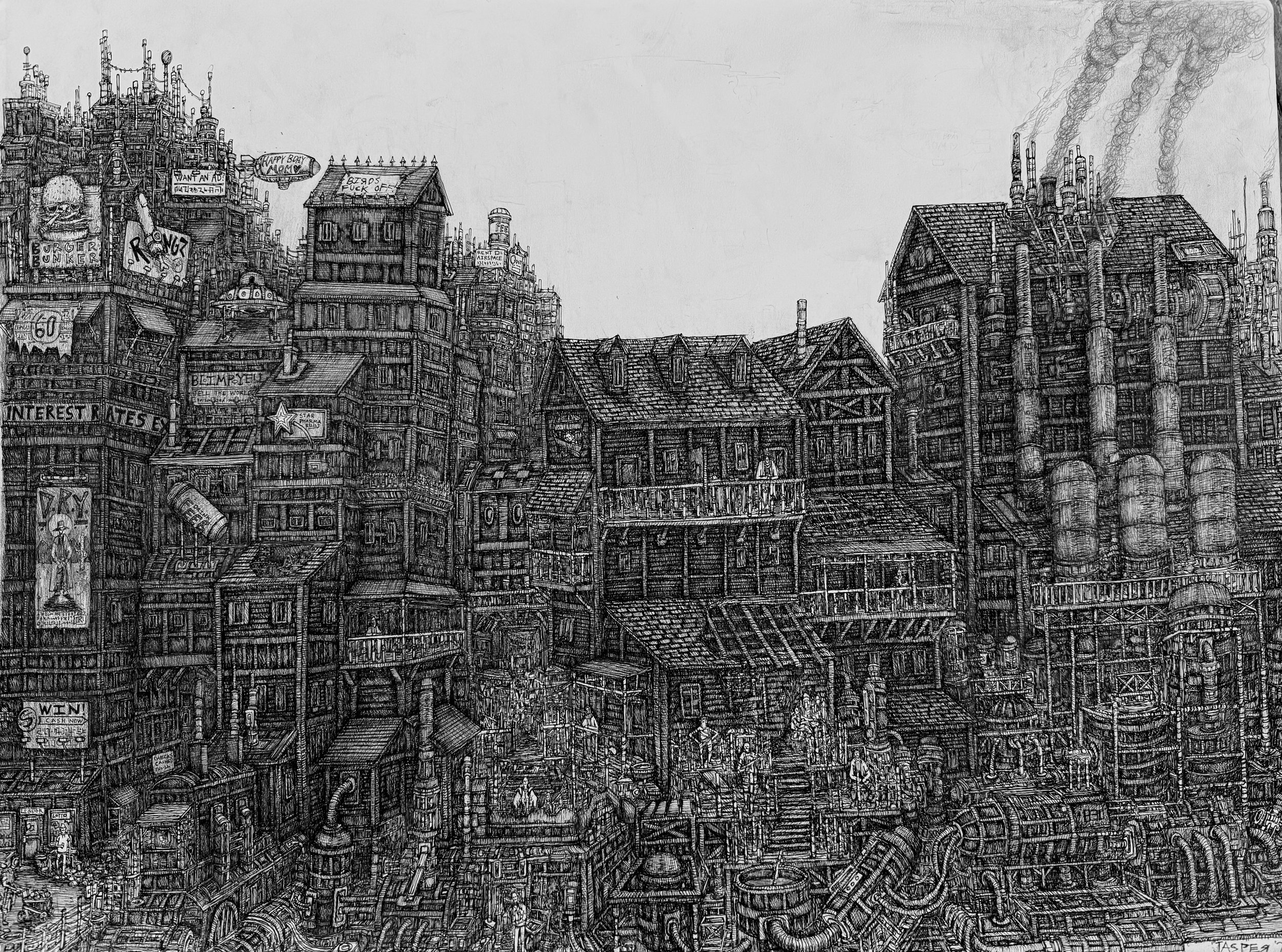
“Industry Takes Feeb City,” 2026
The sky is a void, pale white and deceptively shallow-seeming. Streetwalkers and vagrants scream through the early hours of the morning, lamenting how “the Government stole our clouds.”
The Feeb Industries factory workers have been “on strike” for longer than anyone in this city can remember. Used to be, Feeb production was run straight out of town hall—an essential part of civic operations. This continued until an explosion irreparably wrecked the brewery wing. Amidst the sudden scarcity, the cripplingly-Feeb-reliant populace grew hostile, resentful of a government that failed to provide their liquid lifeblood. In the span of a single night, riots broke out; martial law was declared by morning. Because local law enforcement were themselves involved in the rioting, the Feeb City government had to outsource riot control efforts to a Dicklin Civic Protection, a private military firm whose contractors made things worse. Looting, pillaging, murdering—the whole deal.
It took them eight years to build a dedicated Feeb factory. They converted what was once the city’s historic old town into three hectares of horrifically imposing buildings surrounded by a sprawl of industrial spaghetti. In doing so, Feeb City had to cede most of its municipality to surrounding cities and corporations. Everything was monetized for the sake of fundraising. Meanwhile, the populace became so demoralized that, upon the factory’s completion, it was nearly impossible for Feeb corporate management to find anyone to employ. Of course, those they did find organized unions almost immediately, refusing to work without sufficient Feeb. Workers needed to produce Feeb refused to work without their Feeb.
The neighborhoods surrounding the factory development became a wasteland, haunted largely by ex-Dicklin contractors and Feeb-starved vagrants. Families stay inside for the most part. Birth rates declined exponentially. The children that remain run around aimlessly, sometimes alongside parents, gawking at gleaming new ads from the City’s corporate benefactors. Every so often, a blimp will fly by, inscribed with a hopeful message. It is the most a lot of us have to look forward to.
Feeb City’s relationship with its beverage namesake has grown shiftier and more complicated year by year. Feeb—described clumsily in Wandesia Lemmings’s People’s History of Feeb City as “the grease to the wheels of time itself”—is the most prolific and influential liquid product in the history of mankind. Initially, it landed on store shelves as a no-frills energy drink, with beginnings as a humble snake oil (advertised early on as “The ‘Snake Oil’ that Works!”). The earliest formula was slung by a cabal of associate merchants in pre-industrial times, before being caught up in the Great Commercialist Sweep, whereby the resources and consumables of the old world were picked up and converted into premium products. Historians argue that the Sweep was heralded almost exclusively by Feeb.